Guinea Pigs make fantastic pets for children. Also known as a “Cavy” and they are social and very affectionate. Apart from a regular checkup with your local vet to catch any potential illness ahead of time, there is no reason for a Guinea Pig to be any more trouble than a cat or a dog.
Parasites can become a problem, but generally aside from lice and mites not many other bugs affect the furry little creatures. Caring for your guinea pig should be a loving activity. As they like to sleep in and under straw, hay, and other soft surroundings, new bedding can be a problem with mites and lice. Lice can be seen in some cases, and if they are present, they can cause intense itchiness for your little friend.
Feeding your guinea pig is dependant on what you feed them in the first few weeks of their life. They will take a fancy to whatever it is you feed them during this time, and that will tend to be their preferred diet for life.In the initial phase of their life, feed them a good range of food, like grass, hay, fresh fruit and vegetables. Occasionally feed them pellets, but caring for your guinea means providing a good balanced diet, so don’t overdo the pellets.
Tuesday, July 13, 2010


Thursday, June 10, 2010
FRACTURED LEG OF BABY GUINEA PIG

This baby guinea pig was hurt by his father accidently which resulted in the fracture of the leg. He was making terrible noises because of pain and radiograph cleared the picture. The support has been given to the injured leg to restrict its movement. With time it should heal properly.
Wednesday, June 9, 2010
CORNEAL ULCER - DOG

this dog is having corneal ulcers and will take time to heal as the dog is always rubbing the eye with the paw.
Monday, June 7, 2010

MALIGNANT TUMOR - DOG

german shepherd dog had minor injury on the fore limb. it went unnoticed but dog started limping quite often and even radiograph showed no visible bone injury. After few months the limping was quite painful to dog. At that time radiograph showed some impressions over the joint and dog was put on pain killers. But this didn't help the dog. Finally biopsy was sent to the lab for histopathology and it confirmed the maligant mesenchymal carcinoma. Few more radiographs were done to find out the spread of cancer and prognosis at this stage. But it was too late to help the poor dog and pain was too much to him. Only good thing is that dog is full of life and want to fight with the end.
Thursday, June 3, 2010

Wednesday, June 2, 2010
HOW TO GIVE TABLETS TO RABBIT
 Giving oral medication -
Offer the tablet to your rabbit in the palm of your hand. Some take the pill easily this way, especially if the medication does not have a bad taste.
OR
Hide the whole tablet inside a piece of your rabbit's favorite food. A good food to use for hiding a pill is banana or apple.
OR
Grind up the tablet and mix the ground pill into apple sauce, banana, yogurt, or some vegetable. Put the food in a small dish and place it on the floor for your bunny to eat.
OR
Dissolve the tablet in water or fruit juice and then administer it to the rabbit using a syringe.
OR
Hide the whole tablet inside a piece of your rabbit's favorite food. A good food to use for hiding a pill is banana or apple.
OR
Grind up the tablet and mix the ground pill into apple sauce, banana, yogurt, or some vegetable. Put the food in a small dish and place it on the floor for your bunny to eat.
OR
Dissolve the tablet in water or fruit juice and then administer it to the rabbit using a syringe.
Tuesday, May 25, 2010
SYMPTOMS OF EAR INFECTION
 Infection of the outer ear canal by parasitic organisms like bacteria and yeast is common in cases of canine ear infections. The condition is medically known as Otitis Externa.
Symptoms:-
Bad odor in ears
Black or yellow discharge from ears
Lethargy and irritation
Scratching or rubbing of head and ears
Signs of painful or tender ears
Visible redness in ear flap or canal
Vigorously shaking the head or tilting it to one side
Friday, May 21, 2010
ANAL GLANDS FUNCTIONING
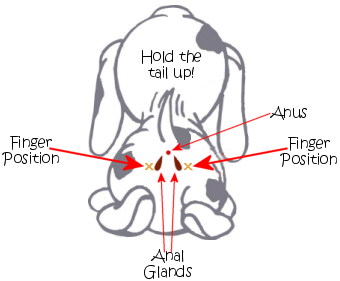
Every dog has two anal glands or sacs which are occasionally refereed to as "scent glands", because they enable the dog to mark its territory. The anal sacs are normally emptied by rectal pressure during defecation. The secretion from the anal glands is a brownish liquid, although is can become thick, yellowish or creamy looking. The anal sacs can also be emptied by contraction of the anal sphincter. This involuntary contraction can be due to the dog being upset, frightened or under pressure, or the contractions can be triggered by the dog to leave its mark upon territory. When the anal glands fail to empty normally, the result can be impaction which is most common in small breeds, but can occur in any dog. Among the causes of anal gland impaction are : soft stools, small anal gland openings and overactive anal glands. The anal gland secretions become thick and pasty.
Thursday, May 20, 2010
TRIMMING YOUR GUINEA PIG'S NAILS

The most difficult part of doing nail trims is probably holding the guinea pig still. You can do it successfully with patience and practice as your guinea pig will likely get less squirmy over time. It is best to have a helper to hold your guinea pig so you can trim the nails.
Nails should be trimmed at least once a month, although you can do them even more often that that if you choose. Although nail clipping may be difficult at first, the more often you do it the more comfortable it will become for you and your guinea pig. The longer the nails get, the harder they will be to trim. As the nails get longer the blood vessel gets longer too, and the nails will start to curl. Regular nail clipping helps keep the nails in good shape.
Wednesday, May 19, 2010

Tuesday, May 18, 2010

Tuesday, May 11, 2010
Monday, May 10, 2010
LYMPHOMA IN DOG
 Lymphoma in dogs is one of the common problem and is very lethal. In 90% of the cases, it is malignant in nature. The dog may live from 5-9 months with the treatment and may live longer if the combination therapies are used.
Friday, May 7, 2010

Sunday, May 2, 2010
DOG WITH PAINFUL LIMP

This is the radiograph of a pug which was having tremendous pain due to femur head problem. He was not able to walk properly. The dog was operated upon to relieve the problem and finally he was free from the pain and is living a healthy and pain free life.
Saturday, May 1, 2010
ABC TO TRAIN YOUR DOG

Every owner want a well trained dog but few put their efforts for this job. You can do this by following the ABC approach i.e. 26 ways to train them in a happy and well trained dog.
A - Always approach your dog with a smile.
B - Be friendly to your dog
C - Call him/her by name
D - Deal positively with your dog's demands
E - Ease your dog with positive reinforcement
F - Find and fulfill your dog's needs
G - Groom your dog regularly to share the bond
H - Hear to your dog's expressions
I - Intensify your love to your dog and he will reciprocate
J - Just remember that your dog can be a stress buster for you
K - Keep yourself calm when your dog makes a mistake
L - Learn from your dog
M - Manage your dog with love
N - Never threaten your dog
O - Open your heart as your dog is an intelligent pet
P - Provide a friendly and safe environment to your dog
Q - Quality life is the right of your dog
R - Respect your dog
S - Satisfy your dog's curiosity
T - Take your dog for outings
U - Utilize your dog's talent
V - Value your dog's potential
W - Work with your dog and be patient
X - Exhibit your genuine concern
Y - You must reward your dog for a good job
Z - Zeroed on to provide a comfortable environment to your dog
Thursday, April 29, 2010
HOW TO REMOVE A TICK FROM YOUR DOG

Ticks are creepy insects that carry and spread diseases to both humans and animals, including Lyme disease, tick fever, Q fever, and more. In order to reduce or prevent disease, you must properly remove a tick as soon as it is discovered and dispose of it appropriately.
Here is how to remove a tick correctly:
The proper way to dislodge the tick is it with tweezers. Go at the tick more from the side than the top. Try to get the tweezers between the skin and the tick's jaws, and gently pull, by moving the tweezer a little with a side-to-side motion. A steady pull over a few minutes time, will usually tire out the tick enough to release its grip. Be gentle, yet firm. otherwise tick may leave its mouth part in your dog's body and that will be a serious problem. You should pick the mouth parts out like a splinter. if you are not sure enough, take the help of your vet to ease the dog.
Wednesday, April 28, 2010
CORNEAL ULCERS

corneal ulcer - Recurrent ulcers and refractory ones that do not heal properly occur more commonly in middle-aged and older dogs.
Clinical Signs - The cornea lacks the presence of blood vessels, it is well equipped with nerves to detect pain. Even the slightest injury will provoke considerable discomfort. Other signs of corneal ulcer include blepharospasm, epiphora, purulent ocular discharge, and photophobia.
Symptoms - Common symptoms of corneal ulcer include pain, squinting or blinking the affected eye, pawing or rubbing at the eye, excessive tearing or discharge, pus, redness, and behavioral changes such as hiding or avoiding light.
Description - The cornea, or front of the eye, has three very important functions. It acts as a supportive barrier to keep the internal structures in place within the eye. The cornea allows light to pass into the eye and thus through the lens to the retina at the back of the eye. It also bends the incoming light rays to aid the lens in focusing the incoming light. The cornea is composed of five microscopically identifiable layers. When the cornea is injured, the extent to which these layers are involved will determine the severity of the injury, the treatment required and the prognosis for saving the eyesight in the injured eye. Recurrences are common and complications are highly likely. Significant corneal disease and ulceration associated with herpesvirus infections in cats are unpredictable in their response to treatment.
Tuesday, April 27, 2010


Sunday, April 25, 2010
CORNEAL ULCERS IN DOGS

Corneal ulcers affect the cornea of the transparent and dome-shaped film that covers the eye. Pet health can get affected due to corneal ulcer, which can also lead to lack of proper eyesight in dogs. Even the smallest abrasion to your pet’s eye can lead to corneal ulcer. Symptoms of Corneal Ulcers
1. Squinting
2. Redness
3. Increased tearing
4. Cloudiness of the cornea
5. Yellow or green color discharge from the eye
6. Inflamed, red conjunctiva
1. Squinting
2. Redness
3. Increased tearing
4. Cloudiness of the cornea
5. Yellow or green color discharge from the eye
6. Inflamed, red conjunctiva
7. Rubbing excessively at the eye
8. Occasional lethargy
9. Pawing at the infected eye
8. Occasional lethargy
9. Pawing at the infected eye
Saturday, April 17, 2010


Thursday, April 15, 2010
GUINEA PIG FOOD
 Guinea pigs are extremely cute animals and they also pretty smart. Veterinarians recommend that guinea pig treats should only equal out to 20% of the overall diet. This means that most of the time the guinea pig should only receive the pellets as food. Treats should only be given on special occasions around 2 to 3 times a week.
Carrots are known to be one of the guinea pigs favorite treats. They should be cut in very small sections because of the risk of the animal choking on them. Only place a few of the pieces in the cage at a time and wait for the guinea pig to eat all of them before you give them more. They also love green, leafy vegetables. You can tear them into small pieces and feed them to the guinea pig. Always remember to wash all the vegetables thoroughly before you feed them to the animal.
Any kind of fruit can be given as guinea pig treats. Apples, cherries, blueberries and grapes are some of the most commonly liked favorites and they are also healthy for the guinea pig.
Wednesday, April 14, 2010
An inujred Duckling

A 4 day old duckling had the fracture as he was attacked by adult mate of the group.
Subscribe to:
Posts (Atom)