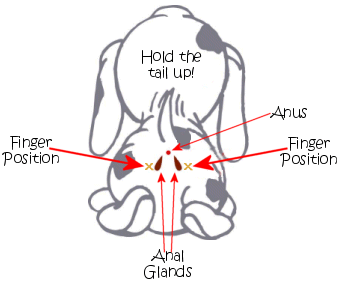
Every dog has two anal glands or sacs which are occasionally refereed to as "scent glands", because they enable the dog to mark its territory. The anal sacs are normally emptied by rectal pressure during defecation. The secretion from the anal glands is a brownish liquid, although is can become thick, yellowish or creamy looking. The anal sacs can also be emptied by contraction of the anal sphincter. This involuntary contraction can be due to the dog being upset, frightened or under pressure, or the contractions can be triggered by the dog to leave its mark upon territory. When the anal glands fail to empty normally, the result can be impaction which is most common in small breeds, but can occur in any dog. Among the causes of anal gland impaction are : soft stools, small anal gland openings and overactive anal glands. The anal gland secretions become thick and pasty.
Showing posts with label rectal prolapse. Show all posts
Friday, May 21, 2010
Monday, March 29, 2010
RECTAL TUMOR IN DOG
Rectal tumors are usually seen as a rectal growth on the animal, and is common to find the disease in the lymph nodes.
Symptoms
The most common sign of anal gland cancer is a rectal mass or tumor. The tumors are often small in nature. In addition to the visible signs of a tumor, animals who are suffering from the disease may be constipated or have difficulty defecating, anorexia, polydipsia, and lethargic.
Causes
The disease is often associated with a hormone imbalance as it is often found in the anal area. It is also linked with hypercalcemia in the animal's body.
Treatment
Symptoms
The most common sign of anal gland cancer is a rectal mass or tumor. The tumors are often small in nature. In addition to the visible signs of a tumor, animals who are suffering from the disease may be constipated or have difficulty defecating, anorexia, polydipsia, and lethargic.
Causes
The disease is often associated with a hormone imbalance as it is often found in the anal area. It is also linked with hypercalcemia in the animal's body.
Treatment
The overall prognosis for the disease is poor, although surgery can improve the opportunity for recovery.
Labels:
anal gland,
dog,
hormone,
recovery,
rectal prolapse,
surgery,
treatment,
tumor,
vet
Wednesday, June 24, 2009
Subscribe to:
Posts (Atom)


