Showing posts with label anal gland. Show all posts
Showing posts with label anal gland. Show all posts
Tuesday, August 7, 2012
Why are high fiber diets recommended for anal glad disease?
As the dog or cat is viewed from behind, anal glands are located on each side of and slightly below the anal opening, at the 4 o'clock and 8 o'clock positions. A tiny duct or tube leads under the skin to an opening directly beside the anus.
Anal gland impactions, infections, and abscesses can occur. Here is how: For various reasons, such as the conformation of the animal, the thickness of the gland's secretions, or the softness of the stool, these glands and their ducts may become clogged, or 'impacted.' When this occurs, the animal will sit down on its rear quarters and drag its anal area across the floor or ground. This is called scooting. Both dogs and cats may lick the anal area excessively. Impacted anal glands are a very, very common problem for dogs, especially the smaller breeds.
Pets with recurrent anal gland impactions are often placed on a high fiber diet. The high fiber makes the animal's stool more bulky. The stool will put more pressure on the anal glands and hopefully the glands will express themselves when the animal defecates.


Sunday, May 6, 2012


Friday, May 21, 2010
ANAL GLANDS FUNCTIONING
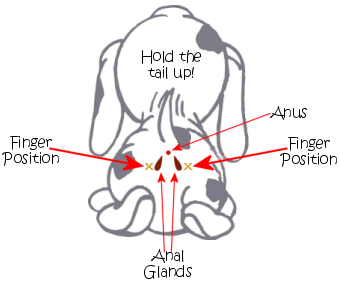
Every dog has two anal glands or sacs which are occasionally refereed to as "scent glands", because they enable the dog to mark its territory. The anal sacs are normally emptied by rectal pressure during defecation. The secretion from the anal glands is a brownish liquid, although is can become thick, yellowish or creamy looking. The anal sacs can also be emptied by contraction of the anal sphincter. This involuntary contraction can be due to the dog being upset, frightened or under pressure, or the contractions can be triggered by the dog to leave its mark upon territory. When the anal glands fail to empty normally, the result can be impaction which is most common in small breeds, but can occur in any dog. Among the causes of anal gland impaction are : soft stools, small anal gland openings and overactive anal glands. The anal gland secretions become thick and pasty.
Monday, March 29, 2010
RECTAL TUMOR IN DOG

Rectal tumors are usually seen as a rectal growth on the animal, and is common to find the disease in the lymph nodes.
Symptoms
The most common sign of anal gland cancer is a rectal mass or tumor. The tumors are often small in nature. In addition to the visible signs of a tumor, animals who are suffering from the disease may be constipated or have difficulty defecating, anorexia, polydipsia, and lethargic.
Causes
The disease is often associated with a hormone imbalance as it is often found in the anal area. It is also linked with hypercalcemia in the animal's body.
Treatment

Symptoms
The most common sign of anal gland cancer is a rectal mass or tumor. The tumors are often small in nature. In addition to the visible signs of a tumor, animals who are suffering from the disease may be constipated or have difficulty defecating, anorexia, polydipsia, and lethargic.
Causes
The disease is often associated with a hormone imbalance as it is often found in the anal area. It is also linked with hypercalcemia in the animal's body.
Treatment
The overall prognosis for the disease is poor, although surgery can improve the opportunity for recovery.
Sunday, December 13, 2009
DOG ODOUR - CAUSES AND HOW TO GET RID OF IT
causes of dog odour and steps to remove it -
1. Wash your dog properly - Too many people do not wash their dogs properly. This can actually make things worse. First, check the dog over thoroughly for any obvious stink sources such as something they rolled in or poop stuck in the fur. Once wet, using a gentle dog shampoo, lather the dog up good and proper. Finally, rinse, rinse, rinse to get all of the shampoo out or it will dry, itch, and cause the dog to produce excess skin oil.
2. Dry the dog thoroughly - It's not just oils and the things the dog rolled in that create dog odor. It's also bacteria and bacteria waste. These bacteria love wet animal fur and are able to live and reproduce quite happily in it. The dogs with thick coats, hit them with a blow dryer. Just make sure you set it on the coolest setting possible.
3. Dog breath - If bad enough, dog breath can make a dog and the house wreak like hell. There are several things you can do to help reduce this odor. The most important is to start a proper oral hygiene regimen. It is often recommended that you brush your dog's teeth once a day. If the dog isn't healthy, it probably won't smell healthy either.
4. Anal glands - secrete an ishy, musty smelling substance with the feces. Sometimes these glands get clogged. This can cause some serious pet odor. A vet or groomer can drain these glands and make Doggy smell pretty again.
5.Ear infections - If the ears look nasty or are stinky, take the dog to the vet. The dog might also just have a skin infection that is causing the smell. It could be a yeast infection, a bacterial infection, or an allergy that has caused an increase in the musty-smelling.
1. Wash your dog properly - Too many people do not wash their dogs properly. This can actually make things worse. First, check the dog over thoroughly for any obvious stink sources such as something they rolled in or poop stuck in the fur. Once wet, using a gentle dog shampoo, lather the dog up good and proper. Finally, rinse, rinse, rinse to get all of the shampoo out or it will dry, itch, and cause the dog to produce excess skin oil.
2. Dry the dog thoroughly - It's not just oils and the things the dog rolled in that create dog odor. It's also bacteria and bacteria waste. These bacteria love wet animal fur and are able to live and reproduce quite happily in it. The dogs with thick coats, hit them with a blow dryer. Just make sure you set it on the coolest setting possible.
3. Dog breath - If bad enough, dog breath can make a dog and the house wreak like hell. There are several things you can do to help reduce this odor. The most important is to start a proper oral hygiene regimen. It is often recommended that you brush your dog's teeth once a day. If the dog isn't healthy, it probably won't smell healthy either.
4. Anal glands - secrete an ishy, musty smelling substance with the feces. Sometimes these glands get clogged. This can cause some serious pet odor. A vet or groomer can drain these glands and make Doggy smell pretty again.
5.Ear infections - If the ears look nasty or are stinky, take the dog to the vet. The dog might also just have a skin infection that is causing the smell. It could be a yeast infection, a bacterial infection, or an allergy that has caused an increase in the musty-smelling.
Subscribe to:
Posts (Atom)