Friday, May 21, 2010
ANAL GLANDS FUNCTIONING
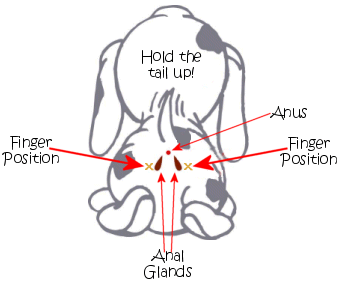
Every dog has two anal glands or sacs which are occasionally refereed to as "scent glands", because they enable the dog to mark its territory. The anal sacs are normally emptied by rectal pressure during defecation. The secretion from the anal glands is a brownish liquid, although is can become thick, yellowish or creamy looking. The anal sacs can also be emptied by contraction of the anal sphincter. This involuntary contraction can be due to the dog being upset, frightened or under pressure, or the contractions can be triggered by the dog to leave its mark upon territory. When the anal glands fail to empty normally, the result can be impaction which is most common in small breeds, but can occur in any dog. Among the causes of anal gland impaction are : soft stools, small anal gland openings and overactive anal glands. The anal gland secretions become thick and pasty.
Thursday, May 20, 2010
TRIMMING YOUR GUINEA PIG'S NAILS
The most difficult part of doing nail trims is probably holding the guinea pig still. You can do it successfully with patience and practice as your guinea pig will likely get less squirmy over time. It is best to have a helper to hold your guinea pig so you can trim the nails.
Nails should be trimmed at least once a month, although you can do them even more often that that if you choose. Although nail clipping may be difficult at first, the more often you do it the more comfortable it will become for you and your guinea pig. The longer the nails get, the harder they will be to trim. As the nails get longer the blood vessel gets longer too, and the nails will start to curl. Regular nail clipping helps keep the nails in good shape.
Wednesday, May 19, 2010
Tuesday, May 18, 2010
Tuesday, May 11, 2010
Monday, May 10, 2010
LYMPHOMA IN DOG
Friday, May 7, 2010
Sunday, May 2, 2010
DOG WITH PAINFUL LIMP
Saturday, May 1, 2010
ABC TO TRAIN YOUR DOG

Every owner want a well trained dog but few put their efforts for this job. You can do this by following the ABC approach i.e. 26 ways to train them in a happy and well trained dog.
A - Always approach your dog with a smile.
B - Be friendly to your dog
C - Call him/her by name
D - Deal positively with your dog's demands
E - Ease your dog with positive reinforcement
F - Find and fulfill your dog's needs
G - Groom your dog regularly to share the bond
H - Hear to your dog's expressions
I - Intensify your love to your dog and he will reciprocate
J - Just remember that your dog can be a stress buster for you
K - Keep yourself calm when your dog makes a mistake
L - Learn from your dog
M - Manage your dog with love
N - Never threaten your dog
O - Open your heart as your dog is an intelligent pet
P - Provide a friendly and safe environment to your dog
Q - Quality life is the right of your dog
R - Respect your dog
S - Satisfy your dog's curiosity
T - Take your dog for outings
U - Utilize your dog's talent
V - Value your dog's potential
W - Work with your dog and be patient
X - Exhibit your genuine concern
Y - You must reward your dog for a good job
Z - Zeroed on to provide a comfortable environment to your dog
Thursday, April 29, 2010
HOW TO REMOVE A TICK FROM YOUR DOG

Ticks are creepy insects that carry and spread diseases to both humans and animals, including Lyme disease, tick fever, Q fever, and more. In order to reduce or prevent disease, you must properly remove a tick as soon as it is discovered and dispose of it appropriately.
Here is how to remove a tick correctly:
The proper way to dislodge the tick is it with tweezers. Go at the tick more from the side than the top. Try to get the tweezers between the skin and the tick's jaws, and gently pull, by moving the tweezer a little with a side-to-side motion. A steady pull over a few minutes time, will usually tire out the tick enough to release its grip. Be gentle, yet firm. otherwise tick may leave its mouth part in your dog's body and that will be a serious problem. You should pick the mouth parts out like a splinter. if you are not sure enough, take the help of your vet to ease the dog.
Wednesday, April 28, 2010
CORNEAL ULCERS
corneal ulcer - Recurrent ulcers and refractory ones that do not heal properly occur more commonly in middle-aged and older dogs.
Clinical Signs - The cornea lacks the presence of blood vessels, it is well equipped with nerves to detect pain. Even the slightest injury will provoke considerable discomfort. Other signs of corneal ulcer include blepharospasm, epiphora, purulent ocular discharge, and photophobia.
Symptoms - Common symptoms of corneal ulcer include pain, squinting or blinking the affected eye, pawing or rubbing at the eye, excessive tearing or discharge, pus, redness, and behavioral changes such as hiding or avoiding light.
Description - The cornea, or front of the eye, has three very important functions. It acts as a supportive barrier to keep the internal structures in place within the eye. The cornea allows light to pass into the eye and thus through the lens to the retina at the back of the eye. It also bends the incoming light rays to aid the lens in focusing the incoming light. The cornea is composed of five microscopically identifiable layers. When the cornea is injured, the extent to which these layers are involved will determine the severity of the injury, the treatment required and the prognosis for saving the eyesight in the injured eye. Recurrences are common and complications are highly likely. Significant corneal disease and ulceration associated with herpesvirus infections in cats are unpredictable in their response to treatment.
Tuesday, April 27, 2010
Sunday, April 25, 2010
CORNEAL ULCERS IN DOGS
Corneal ulcers affect the cornea of the transparent and dome-shaped film that covers the eye. Pet health can get affected due to corneal ulcer, which can also lead to lack of proper eyesight in dogs. Even the smallest abrasion to your pet’s eye can lead to corneal ulcer. Symptoms of Corneal Ulcers
1. Squinting
2. Redness
3. Increased tearing
4. Cloudiness of the cornea
5. Yellow or green color discharge from the eye
6. Inflamed, red conjunctiva
1. Squinting
2. Redness
3. Increased tearing
4. Cloudiness of the cornea
5. Yellow or green color discharge from the eye
6. Inflamed, red conjunctiva
7. Rubbing excessively at the eye
8. Occasional lethargy
9. Pawing at the infected eye
8. Occasional lethargy
9. Pawing at the infected eye
Saturday, April 17, 2010
Thursday, April 15, 2010
GUINEA PIG FOOD
Carrots are known to be one of the guinea pigs favorite treats. They should be cut in very small sections because of the risk of the animal choking on them. Only place a few of the pieces in the cage at a time and wait for the guinea pig to eat all of them before you give them more. They also love green, leafy vegetables. You can tear them into small pieces and feed them to the guinea pig. Always remember to wash all the vegetables thoroughly before you feed them to the animal.
Any kind of fruit can be given as guinea pig treats. Apples, cherries, blueberries and grapes are some of the most commonly liked favorites and they are also healthy for the guinea pig.
Wednesday, April 14, 2010
Monday, April 12, 2010
GUINEA PIG - FOOD LIST
Fruits are high in sugar so it's best to view them more as treats, and avoid any sudden changes in diet. Here is a list of thing which can be fed to guinea pigs :
Red Pepper or green/yellow pepper.- Carrots , Apples, Oranges
Leafy greens like red lettuce, Cucumbers
Broccoli, Green beans, Grapes, Bananas,
Dandelion Greens, strawberries, oranges. - The following is a list of food items to NEVER feed to your guinea pig.
Iceberg lettuce, Any type of cabbage, Cauliflower, Potato peelings, Raw beans, Shelled nuts or seeds, Rhubarb, Meat or fish, Dairy Products. Chocolate or other caffeine-containing products. Cookies/bread, corn kernels or popcorn, sugary foods like donuts, candy, or soda
Ice cream, Any processed or fried foods, Cheese, anything spicy
Sunday, April 11, 2010
Friday, April 9, 2010
My First Book
Wednesday, April 7, 2010
MY FIRST BOOK - DOG CARE
Today, i am feeling extremely happy as my own first book on dogs will be in the market very soon. Finally, after working for long periods and so many years, without knowing the results and the returns; i was able to do this. The book has been titled as "Dog Care - A Guide to Pet Lovers". I would like to express my affection to my husband, my daughter, my whole family, all bundles of joy and all my friends. I need blessings from everyone to continue my work and to do my Karma.
Thanks God for everything in my life.
Tuesday, April 6, 2010
YOUR DOG AND CHOCOLATES
chocolates are toxic to dogs and can almost kill them. Many people think that culprit is caffeine. It is not rather, it is the theobromine in chocolate that is the potential dog killer. How much chocolate will kill a dog? It depends on the age and health of your pet. If your dog is twelve years old and did not have a healthy life; a smaller amount of chocolate might be lethal . Whereas active two years old dog may tolerate it well.
White chocolate will make your dog sick because of the fat content long before the toxic levels of theobromine are reached.
Symptoms of chocolate poisoning - vomiting or diarrhea, trembling, over-excited, or actually start to have seizures. It may fall into a coma and ultimately die. The best thing to do for your pet is to get it to your veterinarian within two hours of the ingestion.
White chocolate will make your dog sick because of the fat content long before the toxic levels of theobromine are reached.
Symptoms of chocolate poisoning - vomiting or diarrhea, trembling, over-excited, or actually start to have seizures. It may fall into a coma and ultimately die. The best thing to do for your pet is to get it to your veterinarian within two hours of the ingestion.
Saturday, April 3, 2010
Friday, April 2, 2010
HOW IS MY E-COLLAR
This is a Hand made Ecollar from the Vanish bottle to stop her licking the surgical site. She is looking pretty happy and beautiful with this pink colored basket. She is absolutely fine after the surgery and will be free from this collar after 2-3 days. hey, can you identify the breed??? I know what it is? But do you know as well??
Subscribe to:
Posts (Atom)

